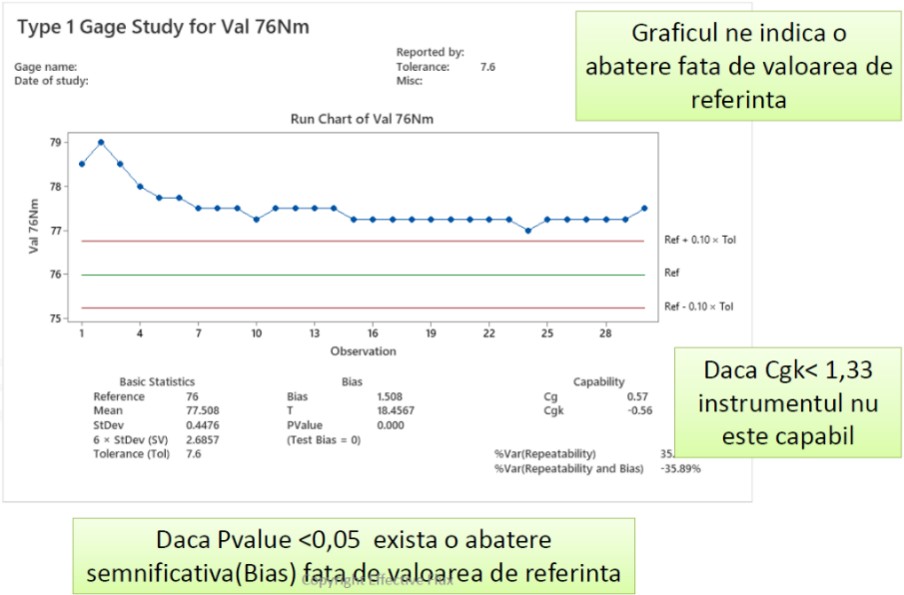
When apply Type 1 Gage study
Manufacturers that use measurement processes for quality control make decisions based on the data measured and collected, so the accuracy of these measurements directly influences the ability to identify nonconformities, control processes and satisfy customer requirements. Evaluating the performance of measurement systems is a key activity in quality management.
Measurement System Analysis (MSA) is the methodology used to determine whether a measurement system is performing or not for the purpose for which it is used. The main objective is to separate and understand the variation generated by the actual process vs. the variation that arises from the measurement instruments and methods, using statistical and experimental methods to evaluate the variation introduced by the measurement system. The measurement system can be influenced by the factor of equipment, the person performing the measurement, the measurement method, the part/characteristic being measured or the working environment.
Type 1 Gage study is important because it provides a quick assessment of the performance of a measuring equipment under controlled conditions, with the main purpose of verifying whether the instrument can measure with sufficient accuracy before being introduced into production or before performing a Gage R&R study.
In carrying out a Type 1 study, a standard part or a characteristic for which the real value is known with a high degree of confidence is used, the reference value is established, then the part is measured approximately 30-50 times consecutively by the same person, and the measurement conditions are maintained constant to eliminate the influence of other sources of variation. Following the study, the Bias is analyzed, which represents the difference between the average of the measurements and the reference value; Repeatability and Capability (Cgk) of the measuring instrument, through the ratio between the variation of the measurement system and the tolerance of the evaluated characteristic.