
Flowchart / Process Map – Where and How to Use It Correctly
The flowchart, also known as the process map, is one of the most widely used tools in process management. Its apparent simplicity, however, often leads to superficial use: maps drawn "for auditing", idealized processes or diagrams that are never used after they are created.
To bring real value, the flowchart must be seen as a tool for understanding, analysis and improvement, not as a documentation exercise.
What is Flowchart (Process Map)
The flowchart, or process map, is a visual representation of the steps that make up a process, from start to finish.
It shows:
- what activities are taking place;
- in what order;
- how information or resources circulate
- where decisions, expectations, or transfers occur.
The result can be a product, service, or information.
In practice, the terms "flowchart" and "process map" are used interchangeably, the differences being more of a level of detail, not of concept.
Where the flowchart is useful
The flowchart can be applied in a wide range of contexts:
- Production processes (assembly, testing, packaging);
- Support processes (maintenance, quality, logistics);
- Administrative processes (ordering, planning, approvals);
- Information flows;
- Design and development – product launch, modifications
- Process Audituri – Internal, External, Customer
- Training and onboarding – understanding the way of working
- Analysis of incidents and recurring problems.
- Troubleshooting
Whenever there is a multi-step process, the flowchart is a good place to start.
- Flowchart in problem solving
In solving problems, the flowchart helps to:
- the exact understanding of the process in which the problem arises;
- the location of the point where the deviation occurs;
- identification of critical decisions and transfers;
- support for root cause analysis.
Without a clear understanding of the flow, the analysis risks being superficial or incomplete.
Flowchart as a foundation for PFMEA
An essential aspect highlighted in the presentation is the fact that PFMEA does not start with risks, defects and scores.
PFMEA starts with understanding the process, and this is done through the flowchart.
Flowchart:
- defines what we analyze;
- establishes the level of detail;
- It provides the structure for:
- Process Item,
- Process Step,
- Process Work Element (4M).
Without a clear map of the process, the PFMEA analysis becomes fragmented and incomplete.
Flowchart in Plan Control
In Plan Control, the flowchart:
- clearly delineate operations;
- indicate potential control points;
- create context for what needs to be checked and where.
Each process step identified in the diagram can generate:
- product features;
- process characteristics;
- risks of non-compliance.
Thus, the flowchart ensures the logical link between the process, risks and control activities.
- Common Mistakes in Using Flowcharts
The most common mistakes are:
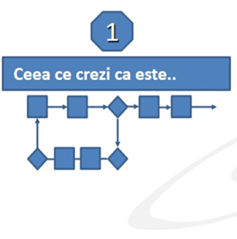
- description of the "ideal" process, not the real one;
 |
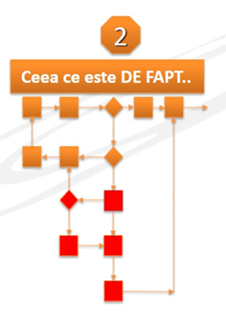 |
- making the diagram without the involvement of people in the field can lead to a theoretical diagram and implicitly to the lack of acceptance;
- a level of detail inadequate to the purpose, either too complex and difficult to understand and use, or too general that does not cover all the steps;
- lack of decision and control points
- Use the chart for auditing only.
- lack of use of the diagram in analysis and improvement.
- Treat the diagram as a static document, made once, at the beginning
A flowchart that isn't used is just a drawing.
Conclusion
The flowchart or process map is a fundamental tool for understanding, controlling, and improving processes. Its value lies not in how beautifully it is drawn, but in how faithfully it reflects reality and in the way it is used.
Used correctly, the flowchart becomes the common language of the process and the starting point for problem solving, risk prevention and continuous improvement.